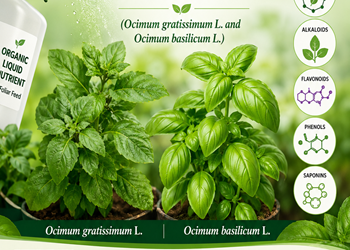
Foliar application of organic liquid nutrient affects selected vitamins and antioxidants in two basils (Ocimum gratissimum L. and Ocimum basilicum L.)
DOI:
https://doi.org/10.33003/chemclass-2026-1002/04
Keywords:
Antioxidants; Lamiaceae; Organic Nutrient; PhytochemicalAbstract
Study was conducted from December 2021 to June 2022 at the screen house of Osun State University, College of Agriculture to evaluate the influence of foliar application of organic liquid nutrient concentrations on the selected vitamins and antioxidant in two species of Ocimum. The experiment was laid out in a Complete Randomized Design (CRD) in ten replications with four treatments of organic liquid nutrient, with varied concentrations (T1: 5 ml/10 liters of water, T2: 10 ml/10 liters of water, T3: 15 ml/10 liters of water and Control: 0 ml). The two species of Ocimum leaf seedlings were nursed for five weeks and were transplanted into each pot at the nursery house. Results showed that for the antioxidant components, alkaloid was higher in O. basilicum with a value of 3.74% compared to O. gratissimum with a value of 3.60% under plants that did not receive organic liquid nutrient. For saponin, both species of Ocimum did not differ significantly (P<_0.05). For plants that received 15 ml/ litre of organic nitrogen, O. basilicum had 8.81% of flavonoid while O. gratissimum had 8.73%. Phenol was also higher in O. basilicum than O. gratissimum. For vitamins and carotene contents of Ocimum gratissimum and Ocimum basilicum, 10ml of liquid organic nutrient had a considerable effect on increasing parameters of both basils. Results showed in Ocimum gratisimum, carotene (mg/100g) was significantly highest at 0ml of liquid organic nutrient (16.37) and lowest at 5ml of liquid organic nutrient (13.33) compared to Ocimum basilicum at 0ml of liquid organic nutrient (13.77). Vitamin C and E was significantly higher in Ocimum basilicum at 0ml nutrient concentration (0.07-27.37) compared to Ocimum gratissimum at 5ml nutrient concentration (0.027) and 15ml nutrient concentration (20.23) respectively.Downloads
Download data is not yet available.
Downloads
Published
2026-06-30
Issue
Section
Original Research Articles
License
Copyright (c) 2026 Funmilayo M. Oloyede, Victoria M. Adegbite, Gbenga G. Daramola (Author)

This work is licensed under a Creative Commons Attribution 4.0 International License.
All the work in this journal are licensed under a Creative Commons Attribution 4.0 International License.
How to Cite
Foliar application of organic liquid nutrient affects selected vitamins and antioxidants in two basils (Ocimum gratissimum L. and Ocimum basilicum L.). (2026). ChemClass Journal, 10(2), 23-27. https://doi.org/10.33003/chemclass-2026-1002/04



 © 2026 ChemClass Journal