History of ChemClass Journal
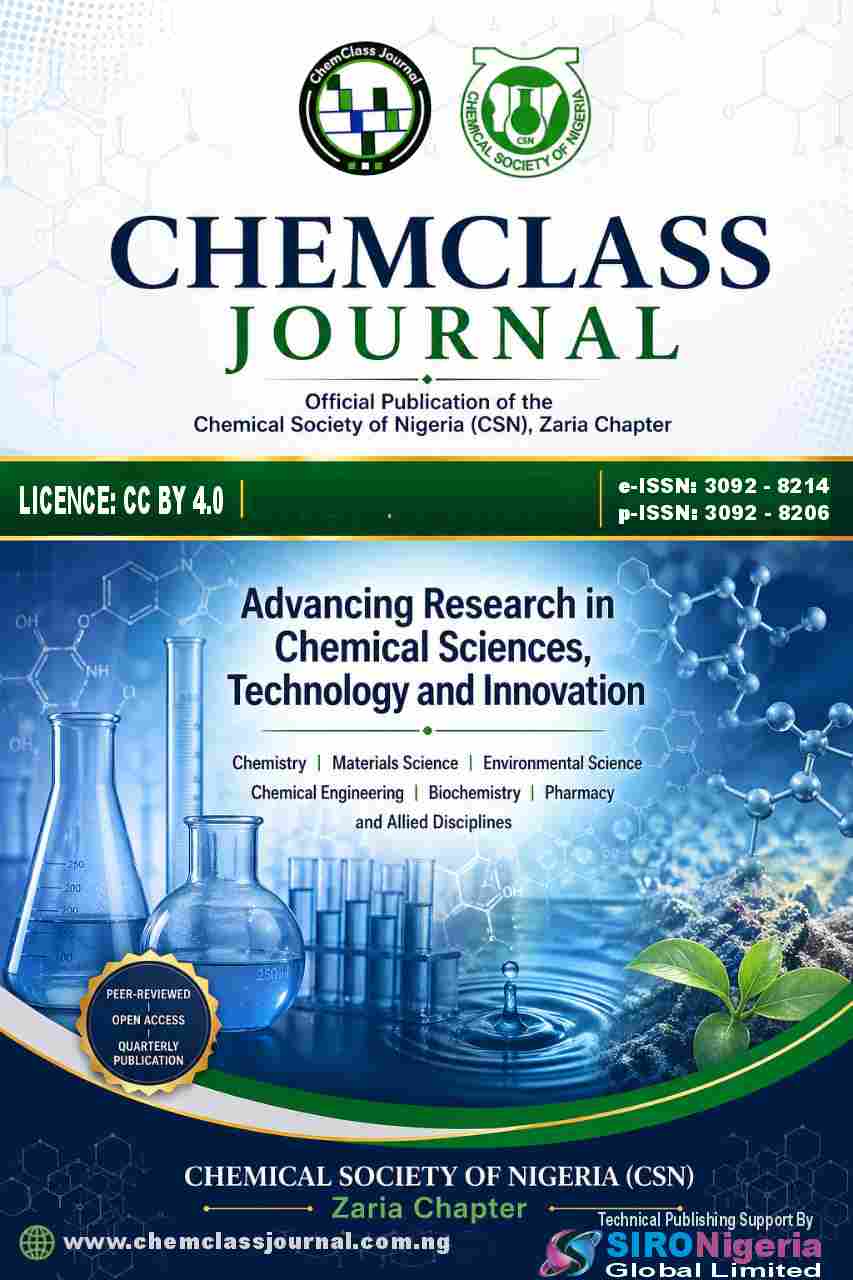
The ChemClass Journal is a scholarly publication of the Chemical Society of Nigeria (CSN), Zaria Chapter, established to provide a structured and internationally visible platform for the dissemination of high-quality research in chemical sciences and related disciplines. The Journal represents the culmination of several decades of scientific engagement, academic collaboration, and professional development within the Zaria scientific community and the broader Chemical Society of Nigeria.
The origins of ChemClass Journal can be traced to the early scientific initiatives of chemists at Ahmadu Bello University, Zaria, who sought to create a collaborative environment to advance the teaching, learning, and application of chemistry. This early initiative led to the formation of what was then known as the Zaria Chemical Society, an informal but highly active platform under the leadership of the late Dr. G.F.S. Harrison of the Department of Chemistry. The Society promoted regular academic seminars, scientific discussions, and periodic scholarly communications that helped to strengthen the culture of chemical sciences research in the region.
As the number of chemists, researchers, and allied professionals in Zaria grew with the expansion of tertiary institutions and research centres, the need for a more structured professional body became evident. This led to the establishment of the Zaria Chapter of the Chemical Society of Nigeria, marking a significant milestone in the institutionalisation of chemical sciences practice in the region. Kaduna State subsequently became notable as the first state in Nigeria to host two active chapters of the Chemical Society of Nigeria, reflecting the strong scientific presence and academic density within the region.
The Zaria Chapter quickly emerged as a vibrant centre of scientific activity, culminating in its successful hosting of the 15th Annual International Conference of the Chemical Society of Nigeria in September 1990. This conference represented a landmark achievement and reinforced the Chapter’s reputation as a hub for scholarly exchange and scientific leadership.
However, like many academic and professional associations, the Chapter experienced a period of reduced activity during the mid-1990s. This phase of dormancy was later reversed through the concerted efforts of dedicated chemists and institutional leaders who were committed to revitalising the Society. Key figures in this resurgence included Dr Femi Peters, then of the Department of Chemistry, Ahmadu Bello University; Dr Okonkwo of the National Research Institute for Chemical Technology (NARICT); and the late Dr Dashe of the College of Leather Technology, now the Nigerian Institute of Leather and Science Technology (NILEST). Their combined efforts led to the reactivation of the Chapter’s governance structure and renewed scientific engagement.
In 1996, these revitalisation efforts culminated in the election of a new Executive Council for the Zaria Chapter, with Dr Femi Peters emerging as Chairman. Under this leadership, the Chapter experienced renewed growth in scientific activities, professional networking, and academic collaboration. One of the most significant outcomes of this revitalisation was the establishment of the ChemClass Conference in 1998.
The ChemClass Conference was conceived as an annual scientific gathering designed to bring together chemists and related professionals to share research findings, discuss contemporary scientific challenges, and promote interdisciplinary collaboration. The maiden edition of the conference was chaired by Prof. V.O. Ajibola and held at the Conference Room of the National Animal Production Research Institute and Livestock Services (NAPRI/NEARLS), Ahmadu Bello University, Zaria. The conference was widely regarded as the first of its kind in the region and quickly became a flagship scientific event for the Chapter.
Over time, the ChemClass Conference became an established platform for scientific discourse and contributed significantly to the growth of research culture within the chemical sciences community. However, it became increasingly clear that a permanent scholarly publishing platform was needed to extend the conference's impact beyond annual gatherings and to ensure the continuous dissemination of research outputs.
This need led to the establishment of the ChemClass Journal, created as the official peer-reviewed publication of the Chemical Society of Nigeria, Zaria Chapter. The Journal was designed to serve as a structured outlet for high-quality scientific research, providing continuity to the intellectual contributions presented at the ChemClass Conference and beyond. It was also intended to enhance visibility, accessibility, and preservation of scholarly work in chemical sciences and related fields.
Since its establishment, ChemClass Journal has evolved into a formal academic publication committed to rigorous peer review, editorial integrity, and adherence to internationally accepted standards of scholarly publishing. The Journal provides a platform for researchers, academics, industry professionals, and policymakers to publish original research articles, review papers, and other scholarly contributions that advance chemical sciences and their applications.
ChemClass Journal continues to reflect the vision and mission of the Chemical Society of Nigeria, which seeks to advance chemistry and related sciences for the benefit of society and national development. It also embodies the Society’s longstanding commitment to raising awareness of chemistry's central role in addressing societal challenges, improving the quality of life, supporting industrial development, and promoting sustainable environmental practices.
Today, ChemClass Journal stands as a symbol of scholarly continuity, institutional resilience, and scientific ambition. It represents the transformation of a local scientific initiative into a structured academic journal with regional and international aspirations. Through its commitment to quality, ethics, and scholarly excellence, the Journal continues to contribute to the global advancement of chemical sciences while maintaining its strong roots in the Nigerian scientific community.



 © 2026 ChemClass Journal