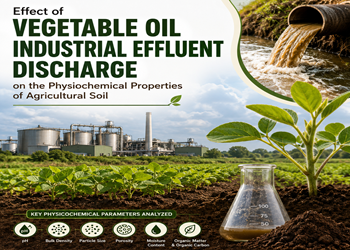
Effect of vegetable oil industrial effluent discharge on the physiochemical properties of agricultural soil
Keywords:
Vegetable oil; Soil; Bulk density; Effluent; WannuneAbstract
This study investigates the effect of vegetable oil industrial effluent discharge on the physiochemical properties of agricultural soil. Soil samples were collected around a soybean vegetable oil industry (Hule & Sons Nig. Ltd) Wannune, Benue State in January 2026. The samples were analyzed for parameters such as pH, bulk density, soil particle size, soil porosity, moisture content, organic matter, organic carbon, exchangeable base, exchangeable acid, base saturation, cation exchange capacity (CEC), and essential nutrients such as total nitrogen, P, Ca, Mg, K and Na using standard methods. Data were analyzed using simple descriptive statistics and results were compared with standards set by regulatory bodies such as Standard Rating of Nigerian Soil (SRNS) and The United State Department of Agriculture Soil Standard Range (USDA SSR). The results of the analysis indicated that the effluents discharged on agricultural soil has no significant effects on the soil as most of the parameters studied fall within the prescribed limit set by the regulatory bodies except for bulk density (1.64 gcm-3) which was slightly above the set limit (0.1-1.6 gcm-3) set by SRNS. The values for pH range between 6.20-6.70, while bulk density, porosity, moisture, organic matter, organic carbon, exchangeable base, exchangeable acid, CEC and base saturation were between 1.25-1.64 1.64 gcm-3, 38.11-52.83 %, 15.56-26.35 %, 1.69-2.52 %, 0.98-1.37 %, 6.99-7.71 cmol kg-1, 1.14-1.19 cmol kg-1, 8.05-8.87 cmol kg-1 and 86.13-86.92 % respectively. Similar results were obtained for essential nutrients with total nitrogen value ranging between 0.10-0.12 %, while P, Ca, Mg, K and Na recorded 9.80-12.10 ppm, 3.94-4.36 cmol kg-1, 2.65-2.90 cmol kg-1, 0.21-0.26 cmol kg-1, 0.19-0.23 cmol kg-1 respectively. The study therefore recommends regular treatment of effluent before discharge to avoid potential health hazard despite having no pollution potentials.Downloads
Download data is not yet available.
Downloads
Published
2026-06-30
Issue
Section
Original Research Articles
License
Copyright (c) 2026 The Authors

This work is licensed under a Creative Commons Attribution 4.0 International License.
All the work in this journal are licensed under a Creative Commons Attribution 4.0 International License.
How to Cite
Effect of vegetable oil industrial effluent discharge on the physiochemical properties of agricultural soil. (2026). ChemClass Journal, 10(2), 70-75. https://chemclassjournal.com.ng/index.php/ccj/article/view/18




 © 2026 ChemClass Journal