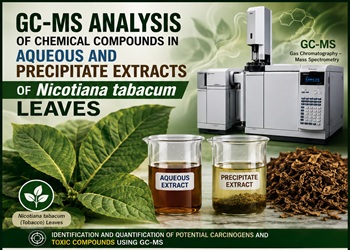
GC-MS analysis of chemical compounds in aqueous and precipitate extracts of Nicotiana tabacum leaves
DOI:
https://doi.org/10.33003/chemclass-2026-1002/15
Keywords:
Tobacco; Tobacco leaves; Nicotiana tabacum; Carcinogens; PAHs; Hydrocarbons; Gas Chromatography-mass spectrometry (GC-MS); NicotineAbstract
Tobacco and its uses have been linked to various adverse health effects, including cancer and cardiovascular diseases. A study was conducted to identify and quantify carcinogens present in Nicotiana tabacum using gas chromatography-mass spectrometry (GC-MS) techniques. The GC-MS analysis of the aqueous extract of Nicotiana tabacum leaves revealed a diverse range of compounds, including ketones, aromatic hydrocarbons, alkenes, alkynes, and heterocyclic compounds. Ketones, such as 9-hydroxy Nonan-2-one, and aromatic hydrocarbons, including Toluene, p-Xylene, and Naphthalene, were detected. Naphthalene is a known human carcinogen that has been linked to various health problems, including cancer. The presence of potential carcinogens, like Toluene, highlights the potential health risks associated with the extract. The analysis also detected alkenes, such as 3,3-dimethyl-But-1-ene, and alkynes, including Octa-2,4-diyne. Heterocyclic compounds, such as Benzofuran and Indene, were also present in the extract. The GC-MS analysis of the precipitate layer of the tobacco leaves extract revealed a diverse range of compounds belonging to various chemical classes. Amines, such as N,N-Dimethylethylamine,(Z)- (RT = 2.284 min), and aldehydes, like 2-Butenal, (Z)- (RT = 3.675 min), were detected. Aromatic hydrocarbons, including Toluene, Benzocyclobutene, and Naphthalene, were detected in the precipitate layer extract. Toluene was one of the most abundant compounds in the extract. The analysis also revealed the presence of epoxides, including 2-ethenyl-2-methyloxirane, and ketones, such as 2-bromo-1-phenyl-Ethanone and 2,2-Dibromo-1-phenylethanone. Phenol, a simple aromatic compound, was detected in significant amounts, with a peak area of 717,623.20. The presence of naphthalene, toluene, and phenol, highlights potential health implications. Naphthalene is classified as (Group 2B) human carcinogen by the International Agency for Research on Cancer (IARC) that may increase the risk of cancer, Toluene shows neurotoxic effect like dizziness, headaches, reduced cognition, while phenol toxicity can cause irritation to skin, eyes, and respiratory tract. This study successfully, identified and quantified chemical compounds present in aqueous and precipitate extracts of Nicotiana tabacum leaves, by Gas Chromatography-Mass Spectrometry (GC-MS) technique, and revealed compounds that are potential carcinogens, and chemical toxicants with serious health implications.Downloads
Download data is not yet available.
Downloads
Published
2026-06-30
Issue
Section
Original Research Articles
License

This work is licensed under a Creative Commons Attribution 4.0 International License.
All the work in this journal are licensed under a Creative Commons Attribution 4.0 International License.
How to Cite
GC-MS analysis of chemical compounds in aqueous and precipitate extracts of Nicotiana tabacum leaves. (2026). ChemClass Journal, 10(2), 106-111. https://doi.org/10.33003/chemclass-2026-1002/15



 © 2026 ChemClass Journal