Proximate composition and mineral content of Cassia tora L. leaves
DOI:
https://doi.org/10.33003/chemclass-2026-1002/02
Keywords:
Cassia tora, proximate analysis, mineral composition, anti-nutritional factors, analytical validation, nutritional valueAbstract
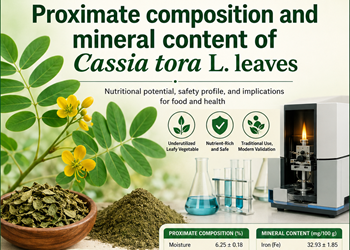
The nutritional potential of underutilized leafy vegetables is increasingly recognized as a strategy to combat micronutrient deficiencies and enhance food security. This study determined the proximate composition, mineral content, anti-nutritional factors, and safety profile of Cassia tora L. leaves, a widely distributed plant in tropical regions with documented traditional uses. Fresh leaves were collected, washed, air-dried, and pulverized. Proximate analysis was conducted using standard AOAC methods with analytical validation (recovery 95.2-102.8%, RSD <5%). Mineral analysis for iron (Fe), zinc (Zn), manganese (Mn), and copper (Cu) was performed using Atomic Absorption Spectrophotometry (AAS) following wet digestion. Anti-nutritional factors (phytate, oxalate, tannins, cyanide) and heavy metal safety (Pb, Cd, As, Hg) were determined using spectrophotometric methods. Results showed that Cassia tora leaves contain moisture (6.25 ± 0.18%), ash (10.33 ± 0.24%), crude fiber (4.08 ± 0.12%), crude fat (8.19 ± 0.21%), crude protein (16.89 ± 0.35%), and carbohydrate (54.25 ± 0.68%) (n=3). Mineral analysis revealed iron (32.93 ± 1.85 mg/100g), manganese (6.95 ± 0.42 mg/100g), zinc (4.39 ± 0.28 mg/100g), and copper (1.28 ± 0.09 mg/100g). Anti-nutritional factors were present at moderate levels: phytate (142.5 ± 8.3 mg/100g), oxalate (89.2 ± 5.1 mg/100g), tannins (45.8 ± 3.2 mg/100g), and cyanide (2.15 ± 0.18 mg/100g). Heavy metals were below safety thresholds (Pb: 0.08 ± 0.01 mg/kg; Cd: 0.02 ± 0.003 mg/kg). The high carbohydrate and appreciable protein content, combined with significant levels of essential minerals, suggest that Cassia tora leaves may possess substantial nutritional value when processed appropriately to reduce anti-nutritional factors. The low moisture content enhances storage stability, while the moderate fat and fiber contents contribute to dietary quality. Safety analysis indicates suitability for consumption within established limits. These findings support further investigation into the traditional consumption of Cassia tora leaves and their potential as a functional food ingredient following appropriate processing for addressing nutritional deficiencies in resource-limited settings.Downloads
Download data is not yet available.
Downloads
Published
2026-06-30
Issue
Section
Original Research Articles
License
Copyright (c) 2026 Yahaya A. Modibbo, Zainab T. Tama (Author)

This work is licensed under a Creative Commons Attribution 4.0 International License.
All the work in this journal are licensed under a Creative Commons Attribution 4.0 International License.
How to Cite
Proximate composition and mineral content of Cassia tora L. leaves. (2026). ChemClass Journal, 10(2), 4-9. https://doi.org/10.33003/chemclass-2026-1002/02



 © 2026 ChemClass Journal