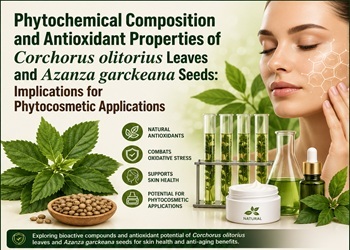
Phytochemical composition and antioxidant properties of Corchorus olitorius leaves and Azanza garckeana seeds: Implications for phytocosmetic applications
DOI:
https://doi.org/10.33003/chemclass-2026-1002/16
Keywords:
Antiaging Potential; Antioxidant Properties; Azanza garckeana; Corchorus olitorius; Phytoconstituents, PhytocosmeticAbstract
Skin aging, particularly photoaging, is largely driven by oxidative stress resulting from reactive oxygen species (ROS). Natural antioxidants from medicinal plants are of interest as potential contributors to skin health, as they may help mitigate oxidative stress mechanisms associated with aging. This study investigated the phytochemical composition and in vitro antioxidant activity of Corchorus olitorius leaves and Azanza garckeana seeds, with emphasis on their relevance to oxidative stress mechanisms associated with skin aging. Phytochemical analyses, both qualitative and quantitative, revealed the presence of bioactive compounds including phenolics, flavonoids, alkaloids, saponins, tannins, terpenoids, and steroids, with notably high levels of phenolics and flavonoids. Antioxidant activities were measured through DPPH, ferric reducing antioxidant power (FRAP), and nitric oxide (NO) radical scavenging assays, along with the assessment of ascorbic acid content. Both plant extracts demonstrated strong, dose-dependent free radical scavenging activities, with ethanolic extracts performing better. The IC50 values for DPPH and nitric oxide scavenging, calculated from triplicate measurements and expressed as mean ± SD, were below 100 µg/mL, indicating antioxidant capacity. When compared with literature reports on commonly used phytocosmetic plants such as Aloe vera, the extracts of Corchorus olitorius and Azanza garckeana demonstrated comparable or strong radical scavenging activity, despite differences in total phenolic content. While Corchorus olitorius is relatively well documented in the literature, Azanza garckeana remains underexplored with limited scientific data on its phytochemical and antioxidant potential, particularly in the context of phytocosmetic applications, making this inclusion a key novelty of this study.Downloads
Download data is not yet available.
Downloads
Published
2026-06-30
Issue
Section
Original Research Articles
License

This work is licensed under a Creative Commons Attribution 4.0 International License.
All the work in this journal are licensed under a Creative Commons Attribution 4.0 International License.
How to Cite
Phytochemical composition and antioxidant properties of Corchorus olitorius leaves and Azanza garckeana seeds: Implications for phytocosmetic applications. (2026). ChemClass Journal, 10(2), 112-119. https://doi.org/10.33003/chemclass-2026-1002/16



 © 2026 ChemClass Journal